 IMMERGITY
Spousal Sponsorship Checker: Quick Answer
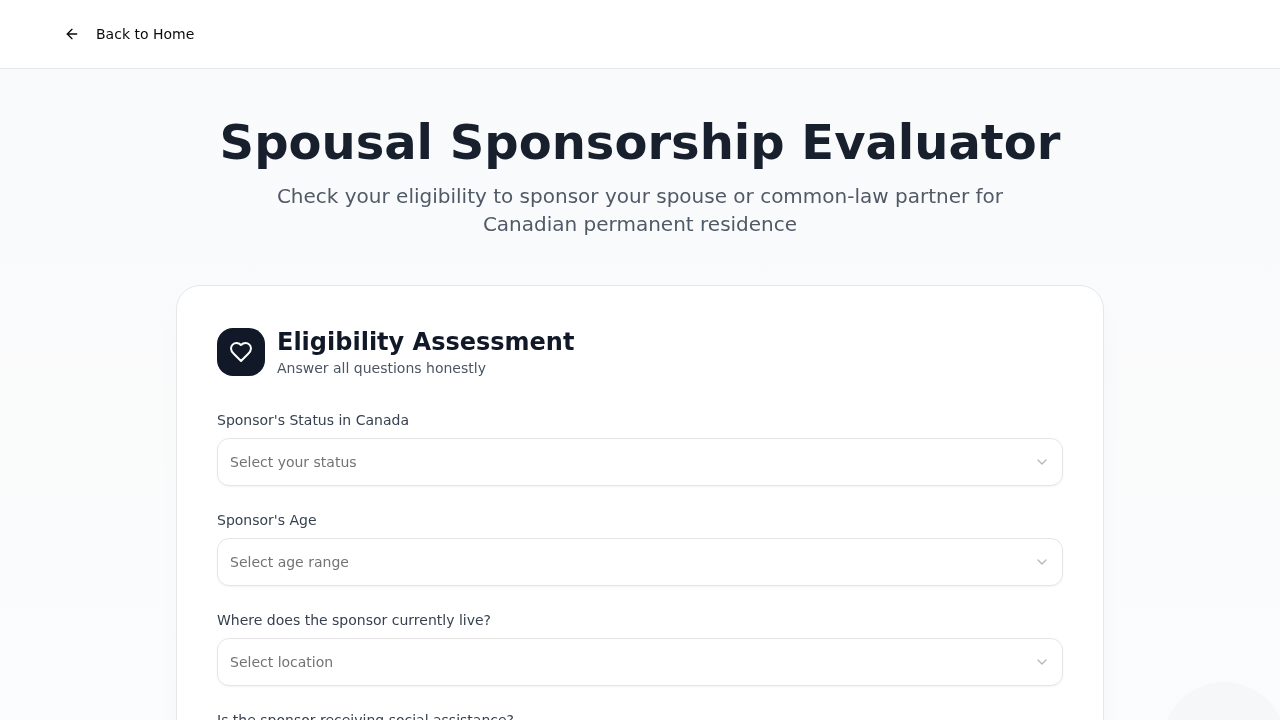
The IMMERGITY spousal sponsorship checker evaluates sponsor eligibility, applicant eligibility, relationship category (spouse, common-law, conjugal), inland vs outland route suitability, document readiness, and common refusal risks — before you start your application. Free, no sign-up required.
Spousal Sponsorship Eligibility Checker Canada 2026
Check both sponsor and applicant eligibility for Canadian spousal, common-law, and conjugal partner permanent residence. Covers inland, outland, and conjugal pathways — and flags criminal record bars, prior sponsorship defaults, and inadmissibility issues.
Check Sponsorship Eligibility →Built by a licensed RCIC (CICC R705848). Free, no sign-up required.
What the Checker Evaluates
The spousal sponsorship checker walks through six areas that determine whether a sponsorship application is on solid ground before filing. Each area corresponds to a common source of refusal or delay.
- Sponsor eligibility — citizenship or PR status, age, residency in Canada, prior sponsorship bar, criminal convictions, bankruptcy, and social assistance
- Applicant eligibility — relationship category qualification, inadmissibility flags (criminal, medical, security), and prior applications
- Relationship category — whether the relationship qualifies as spouse (legally married), common-law (12+ months continuous cohabitation), or conjugal (exceptional circumstances preventing cohabitation)
- Route suitability — inland (spouse in Canada) vs outland (spouse abroad) vs conjugal, with key trade-offs identified
- Document readiness — which core documents are required for your specific situation
- Common refusal risks — flags based on IRCC policy and IAD refusal patterns
Who Should Use This Checker
- Canadian citizens or permanent residents who want to confirm they qualify as a sponsor before filing
- Couples deciding between inland and outland sponsorship routes
- Applicants uncertain whether their relationship qualifies as spousal, common-law, or conjugal under IRCC definitions
- Anyone with a criminal record — sponsor or applicant — who needs to understand the impact before submitting
- Previous sponsors checking whether the 5-year bar applies to them
Current Processing Times — Spousal Sponsorship 2026
Processing times are a key input into the inland vs outland decision. As of March 2026, IRCC's official estimates are:
| Route | Planning Estimate | Key Note |
|---|---|---|
| Outland — outside Quebec | ~15 months | Spouse abroad; processed at overseas visa office |
| Inland — outside Quebec | ~21 months | Spouse in Canada; spousal open work permit available |
| Quebec — outland | ~18–21 months | Includes SAI provincial step (+3–6 months) |
| Quebec — inland | ~24–27 months | Includes SAI provincial step (+3–6 months) |
These are IRCC's 80th percentile estimates — not guarantees. 20% of applications take longer. Verify current figures at the IRCC processing times tool. For the full stage-by-stage breakdown, read the spousal sponsorship processing time guide.
Spousal Sponsorship Eligibility — Who Qualifies
Spousal and partner sponsorship falls under IRCC's Family Class immigration program. It allows Canadian citizens and permanent residents to bring their spouse, common-law partner, or conjugal partner to Canada as a permanent resident. It is one of the most frequently used immigration pathways — and one of the most frequently refused due to eligibility issues that could have been caught before filing.
| Requirement | Citizens | Permanent Residents |
|---|---|---|
| Minimum age | 18 | 18 |
| Must reside in Canada | No (can be abroad, must intend to return) | Yes — must be residing in Canada |
| Income requirement | No minimum income threshold | No minimum income threshold |
| Prior sponsorship bar | 5-year bar if previous spouse was sponsored | 5-year bar if previous spouse was sponsored |
| Criminal record impact | Certain offences = permanent or temporary bar | Certain offences = permanent or temporary bar |
| In default of prior undertaking | Disqualified until resolved | Disqualified until resolved |
| Receiving social assistance | Disqualified (except disability-related) | Disqualified (except disability-related) |
| Undischarged bankruptcy | Disqualified | Disqualified |
| Relationship Type | Minimum Requirement | Key Evidence Required |
|---|---|---|
| Spouse | Legally married in both countries | Marriage certificate, photos, communication records, travel records together |
| Common-law partner | 12+ months continuous cohabitation in a conjugal relationship | Joint lease or mortgage, shared financials, utility bills at same address, statutory declarations |
| Conjugal partner | 12+ months relationship; cohabitation prevented by exceptional circumstances | Evidence of relationship depth + evidence of barriers to cohabitation (immigration bars, legal prohibition, religious reasons) |
Inland vs Outland vs Conjugal — Route Comparison
| Factor | Inland | Outland | Conjugal |
|---|---|---|---|
| Where applicant lives | In Canada with valid status | Outside Canada | Outside Canada (cannot relocate) |
| Planning estimate (March 2026) | ~21 months | ~15 months | Similar to outland |
| Spousal open work permit | Yes — filed simultaneously | No | No |
| Travel during processing | Restricted — ARC required to leave | Freely | Freely |
| Difficulty of approval | Standard | Standard | High — exceptional circumstances required |
| Who qualifies | Spouse/common-law in Canada on valid status | Spouse/common-law abroad | Partners who cannot marry or cohabit due to exceptional barriers |
Common Refusal Risks — Spousal Sponsorship Canada
These are the most frequent grounds for spousal sponsorship refusal based on IRCC policy and Immigration Appeal Division (IAD) case patterns. The checker flags which of these apply to your situation.
| Refusal Category | IRCC Basis | Possible Remedy |
|---|---|---|
| Genuine relationship doubt | IRPA s.4 — bad faith or marriage of convenience | Stronger, varied evidence package; IAD appeal if refused |
| Sponsor ineligibility — prior sponsorship | 5-year bar from sponsoring a previous spouse | Wait out the bar period or pursue legal challenge |
| Criminal inadmissibility (applicant) | IRPA s.36 — serious or non-serious criminality | Criminal Rehabilitation (5+ years post-sentence) or Temporary Resident Permit |
| Misrepresentation | IRPA s.40 — false or misleading information | H&C application; potential 5-year application bar |
| Incomplete application returned | Administrative return — clock fully restarts | Refile with complete documents; use document checklist |
| Medical inadmissibility | IRPA s.38 — excessive demand on health/social services | H&C; proof of treatment plan or management |
| Sponsor criminal bar | Specific violent, sexual, or domestic offences | Legal review required — some bars are permanent |
Check Your Eligibility Before You File
The IMMERGITY spousal sponsorship checker evaluates both sponsor and applicant eligibility, flags common refusal risks, and identifies your route — inland, outland, or conjugal. A complete, well-organized application can reduce preventable delays, returned applications, and avoidable evidence gaps.
Open Spousal Eligibility Checker →Built and reviewed by a licensed RCIC (CICC R705848) · immergity.ca · Free, no sign-up required
Official Sources
Frequently Asked Questions
Who can sponsor a spouse for Canadian permanent residence?
Canadian citizens and permanent residents aged 18+ who reside in Canada (PRs must be in Canada; citizens abroad may sponsor with intent to return). You cannot sponsor if you: are in default of a prior sponsorship undertaking, have been convicted of certain violent or sexual offences, are subject to a removal order, received social assistance (other than disability), or sponsored a previous spouse within the last 5 years.
What is the difference between inland and outland spousal sponsorship?
Inland: applicant is in Canada with valid status; includes spousal open work permit option; applicant should remain in Canada during processing. Outland: applicant is abroad; processed at a visa office abroad; approximately 6 months faster as of March 2026 (~15 months vs ~21 months). Both lead to the same permanent residence outcome. Use the checker to see which route you qualify for.
How long does spousal sponsorship take in Canada in 2026?
As of March 2026, IRCC estimates approximately 15 months for outland (outside Quebec) and approximately 21 months for inland (outside Quebec). Quebec applicants add 3–6 months. These are 80th percentile estimates — not guarantees. For the full breakdown, read the processing time guide.
Does a criminal record disqualify a sponsor or applicant?
It depends on the specific offence. Sponsors convicted of certain sexual, violent, or domestic offences are permanently or temporarily barred. Applicants with criminal inadmissibility can apply for Criminal Rehabilitation (if 5+ years since sentence completion) or a Temporary Resident Permit. The sponsorship checker flags offence types and their IRCC impact.
What qualifies as a common-law relationship for IRCC?
12+ months of continuous cohabitation in a conjugal relationship, proven by joint evidence: shared lease or ownership, joint bank accounts, utility bills at shared address, and statutory declarations from both partners. Periodic visits or long-distance relationships do not qualify as common-law. For full details, read the common-law sponsorship guide.
Can a permanent resident sponsor their spouse if they live outside Canada?
No. Permanent residents must be residing in Canada to sponsor. Only Canadian citizens living abroad may sponsor, provided they intend to return when the sponsored person becomes a PR. A PR who has relocated abroad cannot initiate a sponsorship application until they re-establish Canadian residency.
Related guide
Spousal Sponsorship Canada 2026 — Complete RCIC Reference →Inland vs outland, document checklist, government fees ($1,315), common refusal grounds, and step-by-step process — all covered.