 IMMERGITY
Spousal Sponsorship Refusal Reasons Canada 2026 — How to Avoid Every One
The most common spousal sponsorship refusal reasons in Canada 2026 and how to avoid each one.
Part of the IMMERGITY Spousal Sponsorship Canada 2026 — Complete RCIC Guide →
Every year, IRCC refuses thousands of spousal sponsorship applications. Couples who have been together for years, who are legally married, who have done everything right — still receive refusal letters. The reasons are not always obvious, and the consequences are devastating: months of additional waiting, thousands of dollars in reapplication costs, and in some cases, mandatory separation while an appeal works its way through the Immigration Appeal Division.
Official requirements and application forms for family sponsorship are published on the IRCC family sponsorship page.
Understanding why these refusals happen — and exactly how to prevent each one — is the difference between a smooth approval and a two-year nightmare. What follows sets out every major refusal reason, what IRCC officers are actually looking for, and the specific steps that give your application the strongest possible foundation.
Before reading further, use the free Spousal Sponsorship Evaluator at IMMERGITY to confirm your eligibility. Many refusals begin with an eligibility issue that could have been caught before submission.
The Six Refusal Reasons at a Glance
| Refusal Reason | What Triggers It | How to Avoid It |
|---|---|---|
| Relationship not genuine | Thin evidence, inconsistent answers, rushed timeline | Build a layered evidence file: cohabitation, finances, communication, third-party proof |
| Incomplete / disorganized application | Missing forms, unsigned pages, unpaid fees | Use the IMM 5533 checklist; verify every form and fee before submitting |
| Sponsor ineligibility | Undischarged bankruptcy, social assistance, prior sponsorship default | Confirm sponsor eligibility before filing |
| Applicant inadmissibility | Criminality, misrepresentation, medical, prior removal | Disclose fully; address admissibility with legal remedies (TRP, rehabilitation) |
| Inconsistencies between sponsor and applicant | Conflicting dates, locations, or relationship facts across forms | Complete the IMM 5532 sections consistently; cross-check every date |
| Country-specific risk | High-fraud visa post applies extra scrutiny | Provide a stronger, more detailed evidence package than the minimum |
Appeal vs. Reconsideration vs. Reapplication
| Remedy | When It Applies | Timeline |
|---|---|---|
| IAD appeal | Outland refusals where an appeal right exists | 12–24 months on average |
| Reconsideration request | Clear officer error or new decisive evidence | Weeks to a few months (no guarantee) |
| Reapplication | Fixable gaps (evidence, completeness) | Fresh processing timeline from filing |
Pre-Submission Risk Check
| Check | Standard | Consequence If Missed |
|---|---|---|
| All IRCC forms complete and signed | IMM 1344, IMM 0008, IMM 5532, IMM 5406 + checklist | Returned as incomplete or refused |
| Relationship evidence layered | Cohabitation + financial + communication + third-party | Genuineness refusal |
| Sponsor eligibility confirmed | No default, no disqualifying social assistance | Sponsor ineligibility refusal |
| Applicant admissibility addressed | Police certificates, medical, full disclosure | Inadmissibility refusal |
Refusal Reason #1 — Relationship Not Genuine ("Bad Faith")
This is the single most common reason spousal sponsorship applications are refused in Canada, and the most subjective. IRCC officers are trained to assess whether a relationship is genuine and ongoing, or whether it was entered into primarily for immigration purposes. The legal term is "bad faith marriage" — and IRCC does not need to prove fraud. They only need to be not satisfied that the relationship is genuine.
What triggers this finding:
- Couples who met recently and married quickly with limited documented contact before the wedding
- Large age gaps combined with limited shared history
- Inconsistent answers between the sponsor and sponsored person about how they met, key dates, family members' names, or daily life details
- Little to no evidence of ongoing contact — no call records, no photos together, no travel history
- Marriages that were arranged without the couple having met in person before the wedding
- Prior immigration history suggesting a pattern (e.g., a previous spousal sponsorship that ended in separation shortly after PR was granted)
How to Build Genuineness Evidence That Withstands Scrutiny
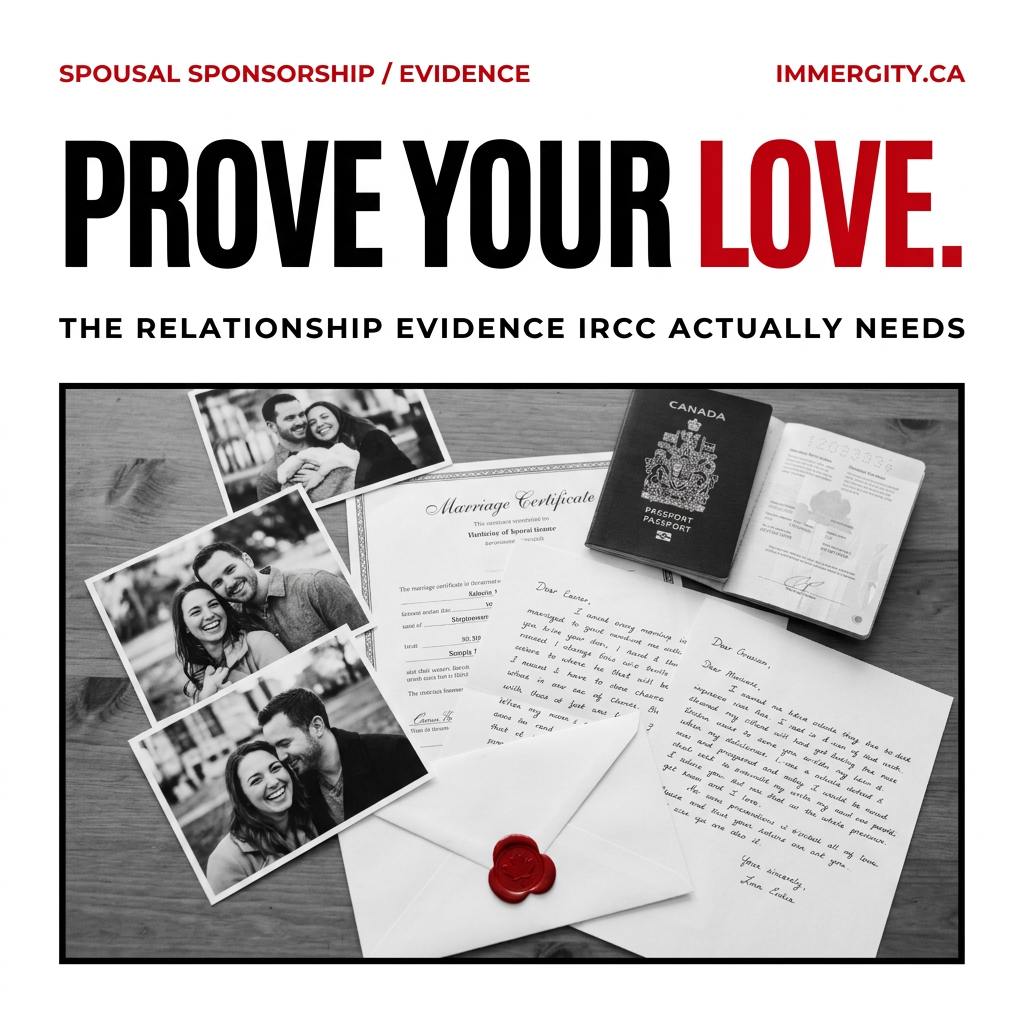
The strength of a genuineness case is built on volume, diversity, and timeline. IRCC is not looking for one perfect piece of evidence. They are looking for a consistent, multi-layered picture of a real relationship that spans years, not weeks.
- Photos — the most important category. Hundreds of photos, not dozens. Photos across multiple years, multiple locations, multiple contexts — family gatherings, travel, daily life at home, weddings, celebrations. Photos with each other's families. Photos that show the relationship progressing naturally over time. Include a photo index with dates and descriptions.
- Communication records. Call logs showing the frequency and duration of calls over months and years. WhatsApp or messaging app screenshots (not just a handful — extensive). Video call history. Email threads. The volume and consistency of communication matter far more than any single message.
- Financial evidence of a shared life. Joint bank accounts, shared credit cards, joint financial decisions, money transfers between the two of you, evidence that you support each other financially.
- Travel records. Passport stamps, boarding passes, and hotel records showing every visit the couple made to each other. The cumulative time spent together in person is critical.
- Statutory declarations. Sworn written statements from family members, mutual friends, and community members who know the couple. These must be specific — describing how they met, events they witnessed, their personal observations of the relationship — not generic character references.
- Evidence of social recognition. Wedding invitations addressed to both. Social media posts. Joint attendance at family events. Evidence that the community around you recognizes and treats you as a couple.
Refusal Reason #2 — Incomplete or Disorganized Application
IRCC processes thousands of applications per week. Officers do not have time to search for missing documents, follow up on incomplete forms, or make assumptions about what an applicant meant to provide. An incomplete application is either returned outright or results in a Procedural Fairness Letter (PFL) — a formal request for additional information that adds months to processing and signals to the officer that the application was not carefully prepared.
Common completeness failures:
- Missing form signatures — every signature field on every form must be signed, dated, and complete
- Photographs that do not meet IRCC's exact specifications (wrong dimensions, no date or studio name on the back, too much or too little white space around the face)
- Documents not translated — any document not in English or French must include a certified translation AND a copy of the original
- Police certificates missing — required from every country the sponsored person has lived in for 6+ months since age 18, including their home country
- Expired documents submitted — police certificates more than 6 months old, passports expiring before the expected processing time
- IME (Immigration Medical Examination) not completed with a designated physician, or completed too early (IMEs have a validity window)
- Missing the Right of Permanent Residence Fee (RPRF) — $600 — sometimes inadvertently omitted
The fix is methodical: work through IRCC's official document checklist for your specific application type line by line, twice, before submission. Then have someone else review it. A second set of eyes catches errors the primary applicant becomes blind to after weeks of preparation.
Refusal Reason #3 — Sponsor Ineligibility
The sponsor — the Canadian citizen or permanent resident — must meet specific eligibility criteria. Failing any one of them results in automatic ineligibility regardless of how strong the relationship evidence is.
Sponsor ineligibility triggers:
- Previous sponsorship default. If you sponsored someone previously and they received social assistance within the undertaking period (3 years for spouses), and the province recovered those funds from you — or is still trying to — you may be in default and ineligible to sponsor again.
- Active bankruptcy. An undischarged bankrupt cannot sponsor. Once discharged, eligibility is restored.
- Criminal record. Certain convictions — particularly for violent offences, sexual offences, or crimes against family members — can disqualify a sponsor. Some disqualifications are permanent; others can be addressed with a waiver application.
- Currently receiving social assistance (for reasons other than disability).
- Permanent residents living outside Canada who cannot demonstrate intent to return when the sponsored person becomes a PR.
- Being under a removal order or having certain outstanding immigration issues.
Use the IMMERGITY Eligibility Assessment to check your full eligibility profile before submitting — it flags potential sponsor eligibility issues before they become refusal letters.
Refusal Reason #4 — Sponsored Person Inadmissibility
Even if the sponsor and the relationship both pass scrutiny, the sponsored person can be found inadmissible to Canada on independent grounds. Inadmissibility is separate from sponsorship eligibility — it relates to the individual's own history and circumstances.
Common inadmissibility grounds:
- Criminal inadmissibility. A criminal record in any country — including charges that were withdrawn, pardoned, or for which the person served their sentence — can trigger inadmissibility depending on the Canadian equivalent offence. Equivalency is assessed under Canadian law, not the law of the country where the offence occurred.
- Misrepresentation. Any false statement, omitted history, or misleading document on any immigration application anywhere in the world — not just this one — results in a finding of misrepresentation, which carries a 5-year ban from all Canadian immigration applications.
- Security inadmissibility. Membership in organizations designated as terrorist or criminal, or involvement in activities contrary to human rights.
- Medical inadmissibility. A condition that is a danger to public health, a danger to public safety, or that would cause excessive demand on Canadian health or social services. This is assessed during the Immigration Medical Examination (IME).
- Previous removal or deportation from Canada without a valid Authorization to Return to Canada (ARC).
Refusal Reason #5 — Inconsistencies Between the Sponsor and Sponsored Person
IRCC officers compare the accounts provided by both the sponsor and the sponsored person independently. When details don't match — dates, places, how they met, what the other person's family is like, living arrangements, future plans — it raises a genuineness concern that is very difficult to overcome after the fact.
This is particularly significant when an interview is requested. Spousal sponsorship interviews are not routine, but they do happen — and they are specifically designed to probe for inconsistencies. Officers ask both parties the same questions separately and compare the answers. Inconsistencies that might seem minor (the date of a first date, the name of a restaurant) are treated as significant red flags.
The preparation imperative: Both the sponsor and the sponsored person need to know their relationship history in detail — not because they are fabricating it, but because memory fades and dates blur. Review your timeline together: when you first contacted each other, when you first met in person, every visit and trip together, key milestones, each other's family members' names, occupations, and where they live. This is not coaching — it is ensuring that two people who genuinely know each other can accurately demonstrate that knowledge under pressure.
Refusal Reason #6 — Country-Specific Risk Flags
IRCC visa offices in different countries operate with different levels of scrutiny based on fraud risk assessments for that region. Applications processed through certain visa offices — historically including some offices handling applications from South Asia, West Africa, and parts of the Middle East — face more intensive review of relationship genuineness and document authenticity.
This is not discrimination in the legal sense — it reflects IRCC's internal risk management based on documented fraud patterns in specific corridors. But the practical effect is that applicants from higher-scrutiny jurisdictions need to provide a stronger, more detailed evidence package than the minimum required.
If your application is processed through a higher-scrutiny visa office, consider submitting:
- An extended personal statement — a detailed narrative of the relationship history, written by both parties
- Notarized or certified copies of all documents where originals cannot be submitted
- Evidence of both families' knowledge of and involvement in the relationship
- If married, evidence of wedding planning, vendor receipts, guest lists, and detailed ceremony documentation
What to Do If Your Application Is Refused
A spousal sponsorship refusal is not the end of the road. The sponsor (the Canadian citizen or PR) has the right to appeal a refusal to the Immigration Appeal Division (IAD) within 30 days of receiving the refusal letter. This is a hard deadline — missing it eliminates the appeal right.
The IAD can:
- Allow the appeal if IRCC's decision was factually wrong or legally incorrect
- Allow the appeal on humanitarian and compassionate grounds even if the refusal was technically correct
- Dismiss the appeal and uphold the refusal
An IAD appeal is a formal legal proceeding. It requires legal representation, evidence preparation, and in many cases, a live hearing where both parties may be questioned. Attempting an IAD appeal without licensed RCIC or legal representation significantly reduces the odds of success.
If an appeal is not filed or is dismissed, the couple can choose to reapply from scratch — addressing the reasons for refusal with a stronger, more detailed application. In this situation, the refusal letter itself is the most valuable document you have: it tells you exactly what IRCC found insufficient.
Your Action Plan — Before You Submit
- Step 1: Use the Spousal Sponsorship Evaluator to confirm sponsor and sponsored person eligibility before preparing a single document.
- Step 2: Build your relationship evidence file systematically — photos indexed by date, communication records exported and organized, travel records compiled, statutory declarations collected.
- Step 3: Work through IRCC's official document checklist line by line. Then verify it again.
- Step 4: Both the sponsor and sponsored person should independently review the relationship timeline and ensure they can accurately recount it in detail.
- Step 5: Use the IMMERGITY Eligibility Assessment to check whether any parallel immigration pathways exist — sometimes a concurrent work permit or Express Entry profile can provide a backup if the sponsorship is delayed.
- Step 6: If your case involves any complexity — prior refusals, criminal history, higher-scrutiny country of origin, misrepresentation concerns — consult a licensed RCIC before submitting. The cost of a consultation is a fraction of the cost of a refusal.
Distance is painful. Refusals make it longer. The free Spousal Sponsorship Evaluator at IMMERGITY is the fastest way to understand where your application stands before IRCC does.
Pressure-test your relationship evidence before filing with the free Spousal Sponsorship Evaluator.
Frequently Asked Questions
Why do spousal sponsorship applications get refused in Canada?
The 6 most common spousal sponsorship refusal reasons in Canada are: (1) relationship not considered genuine — insufficient evidence the relationship is real and ongoing, (2) incomplete or disorganized application — missing forms, photos, translations, or police certificates, (3) sponsor ineligibility — prior sponsorship default, bankruptcy, or criminal record, (4) sponsored person inadmissibility — criminal record, misrepresentation, or medical inadmissibility, (5) inconsistencies between the sponsor and sponsored person's accounts of their relationship, (6) country-specific risk flags — higher scrutiny for applications from certain visa office jurisdictions.
What relationship evidence does IRCC require for spousal sponsorship?
IRCC requires diverse, multi-layered relationship evidence spanning years: hundreds of photos across multiple contexts and locations, call logs and messaging records showing frequency and consistency of communication, joint financial documents (shared accounts, transfers), travel records showing visits (passport stamps, boarding passes, hotel receipts), statutory declarations from family and friends describing specific observations of the relationship, and evidence of social recognition as a couple. Volume, diversity, and timeline are what matter most.
What happens if spousal sponsorship is refused in Canada?
If a spousal sponsorship application is refused, the sponsor (Canadian citizen or PR) has the right to appeal to the Immigration Appeal Division (IAD) within 30 days of receiving the refusal letter. The IAD can allow the appeal if IRCC's decision was factually wrong, legally incorrect, or on humanitarian and compassionate grounds. Alternatively, the couple can reapply from scratch addressing the specific reasons for refusal. Legal representation is strongly recommended for IAD appeals.
What is a bad faith marriage in Canadian immigration?
A bad faith marriage in Canadian immigration is one that IRCC determines was entered into primarily for immigration purposes rather than as a genuine relationship. IRCC does not need to prove fraud — officers only need to not be satisfied that the relationship is genuine. Triggers include recent marriage with limited documented history, inconsistencies between the couple's accounts, minimal evidence of ongoing contact, and patterns suggesting immigration was the primary motivation.
Can a refused spousal sponsorship application be appealed?
Yes. The sponsor (Canadian citizen or permanent resident) can appeal a spousal sponsorship refusal to the Immigration Appeal Division (IAD) within 30 days of the refusal letter. The IAD can overturn the refusal if IRCC's decision was factually or legally wrong, or on humanitarian and compassionate grounds. Missing the 30-day deadline eliminates the appeal right. Licensed RCIC or legal representation is strongly recommended for IAD appeals.
What makes a spousal sponsorship application complete?
A complete spousal sponsorship application includes: all required IRCC forms with every signature field completed (IMM 1344, IMM 0008, IMM 5406, IMM 5562), photos meeting exact IRCC specifications, police certificates from every country lived in for 6+ months since age 18, a completed Immigration Medical Examination by a designated physician, biometrics, certified translations of all non-English/French documents, and full government fee payment including the $600 Right of Permanent Residence Fee.
Is there a free tool to check spousal sponsorship eligibility before applying?
Yes. The IMMERGITY Spousal Sponsorship Evaluator at immergity.ca/insights.immergity.ca/tools/spousal-sponsorship-checker/ is a free tool that checks both sponsor and sponsored person eligibility before any documents are prepared. It flags potential ineligibility issues that could lead to refusal. Free, no credit card, available 24/7. Provided by IMMERGITY, licensed RCIC firm in Mississauga (CICC #R705848).
How long does a spousal sponsorship appeal take in Canada?
An Immigration Appeal Division (IAD) spousal sponsorship appeal typically takes 12 to 24 months from filing to final decision, depending on case complexity and IAD scheduling. The appeal must be filed within 30 days of the refusal letter. During the appeal period, the sponsored person is generally not authorized to come to Canada unless they have an independent valid status.