 IMMERGITY
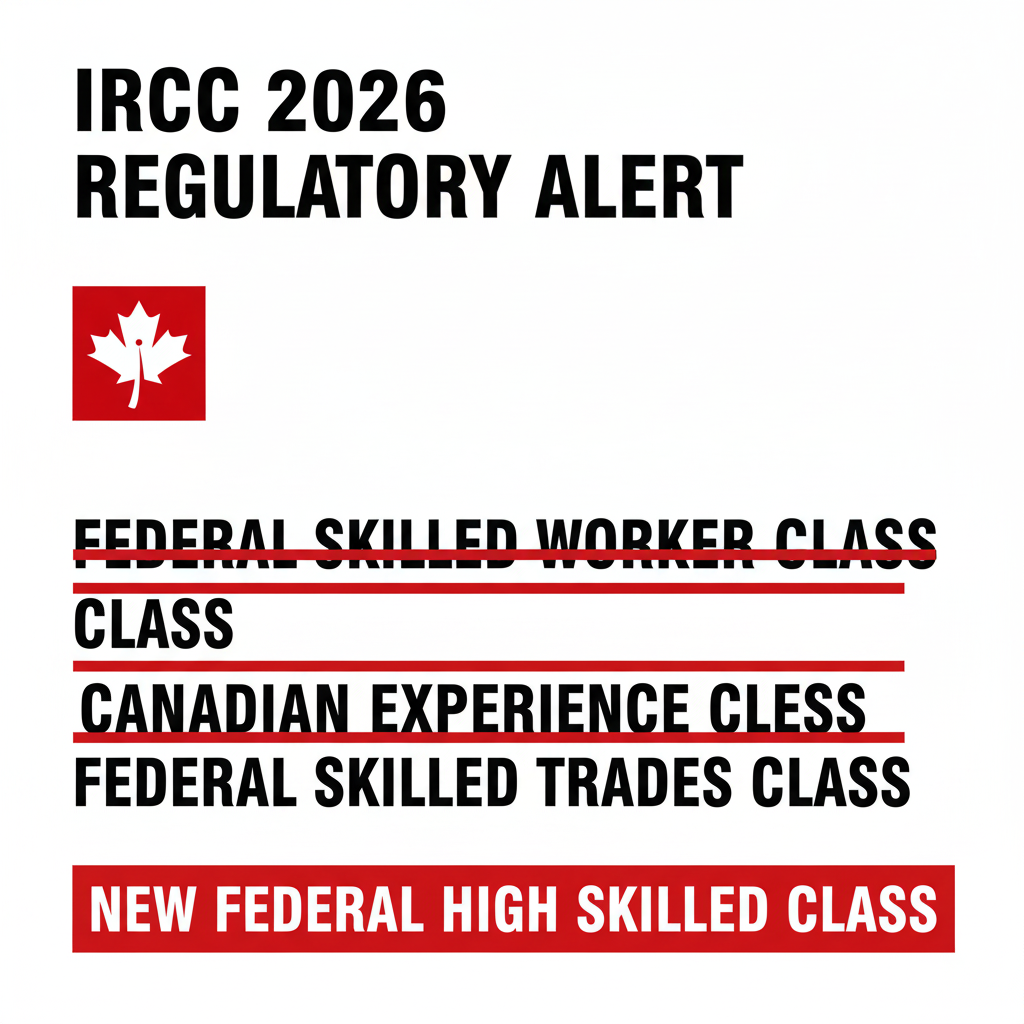
On April 1, 2026, IRCC quietly published one of the most consequential regulatory proposals in the history of Canada's Express Entry system. Buried in the department's Forward Regulatory Plan, the proposal reads: amend the Immigration and Refugee Protection Regulations to introduce a new federal high skilled immigration class with streamlined eligibility requirements, and repeal the existing Federal Skilled Worker Class, Canadian Experience Class and Federal Skilled Trades Class.
That is not a refinement. That is a structural overhaul of the entire federal skilled immigration architecture that has governed 11 years of Express Entry. Every candidate currently in the pool, every applicant planning to enter, and every employer relying on these pathways needs to understand what this means — and what it doesn't mean yet.
Before you read further: use the free Eligibility Assessment at IMMERGITY to establish a baseline of your current eligibility under the existing programs. That baseline will be your reference point as this reform unfolds.
What IRCC Actually Said — The Verbatim Proposal
The regulatory initiative was first included in IRCC's Forward Regulatory Plan on April 1, 2026 (page last updated April 7, 2026). The full description reads:
"Amendments are being proposed to the Regulations to introduce a new federal high skilled immigration class with streamlined eligibility requirements, and repeal the existing Federal Skilled Worker Class, the Canadian Experience Class and the Federal Skilled Trades Class."
— IRCC Forward Regulatory Plan, April 1, 2026. Contact: Jonathan Joshi-Koop, Director, Permanent Economic Immigration, IRCC.
The stated rationale: "Streamlined requirements would ensure that the system is easier for clients, employers and partners to understand and navigate." The proposed benefit: "establishing a more diverse pool of international talent to fill a variety of labour market needs."
Public consultations are planned for Spring 2026. No draft regulations have been published yet.
The Three Classes Being Repealed: What You'd Lose Under Current Rules
To understand the magnitude of this reform, you need to understand what each class currently does — and why the distinctions matter to real candidates.
| Program | Core Eligibility Requirement | Key Differentiator | Who Uses It Most | 2026 Status |
|---|---|---|---|---|
| Federal Skilled Worker (FSW) | 1 year skilled work experience (TEER 0, 1, 2, or 3) in last 10 years + 67/100 points on selection grid | Open to overseas candidates; does NOT require Canadian work experience | Skilled foreign nationals applying from abroad; international professionals | Active — remains the primary international pathway |
| Canadian Experience Class (CEC) | 1 year skilled Canadian work experience (TEER 0, 1, or 2) in last 3 years | Requires Canadian work experience; no language test required for TEER 0/1 beyond CLB 7 | International graduates, TFWs, post-graduate work permit holders | Active — dominant program; most CEC draws clearing at 505–509 CRS in 2026 |
| Federal Skilled Trades (FST) | 2 years skilled trades experience in last 5 years + job offer or trade certification | Targets TEER 2/3 trades occupations; different language requirements (CLB 5 speaking/listening, CLB 4 reading/writing) | Electricians, plumbers, carpenters, heavy equipment operators | Active — but superseded in practice by Trades category draws since 2023 |
The FSW 67-Point Grid: What Would Disappear
The most consequential element of the FSW repeal would be the elimination of the 67-point pre-pool selection grid. Currently, overseas candidates must score at least 67 out of 100 points across six factors before they can even enter the Express Entry pool:
| FSW Selection Factor | Maximum Points | Key Thresholds | RCIC Note |
|---|---|---|---|
| Language skills | 28 points | CLB 9 = 6 pts/ability; CLB 10+ = 6 pts/ability | Single highest-leverage factor; retesting ROI is exceptional |
| Education | 25 points | Master's/PhD = 25 pts; bachelor's = 21 pts | Foreign credentials require ECA from designated body |
| Work experience | 15 points | 1 yr = 9 pts; 3+ yrs = 11 pts; 6+ yrs = 15 pts | Must be TEER 0, 1, 2, or 3 — NOC alignment is critical |
| Age | 12 points | Age 18–35 = 12 pts; declines by 1 pt/year after 35 | Age 47+ = 0 pts; this is the only truly immovable factor |
| Arranged employment | 10 points | Valid job offer from Canadian employer = 10 pts | LMIA-backed offers add CRS points separately in the pool |
| Adaptability | 10 points | Previous Canadian study/work, spouse education, relatives in Canada | Often overlooked — Canadian study alone adds 5 pts |
If the FSW class is repealed and replaced with a unified class that removes this pre-pool grid, it could theoretically allow a broader range of candidates to enter the pool — but the CRS ranking mechanism would still determine who actually receives ITAs. The 67-point screen would cease to function as a gatekeeping tool, but pool competition dynamics would remain.
My Opinion: What IRCC Is Actually Trying to Fix
As a Regulated Canadian Immigration Consultant (RCIC, CICC #R705848) who has worked with hundreds of candidates navigating these three classes, I want to be direct about what this proposal is and isn't.
What it IS: A long-overdue architectural simplification. The FSW/CEC/FST distinction has created a system where candidates with substantively similar profiles receive different outcomes based on whether their skilled work experience happened to occur in Canada vs. abroad, or in a trade vs. a "skilled" occupation. The 67-point FSW grid is a legacy mechanism from the pre-2015 paper-based system that has always been awkward inside the CRS ranking environment. IRCC is right that the system has become unnecessarily complex.
What it ISN'T: An amnesty, a lowering of standards, or a fast-track for low-skilled workers. The proposal explicitly says "federal high skilled immigration class" — the word "skilled" is doing real work in that sentence. The elimination of program-specific barriers is not the same as eliminating the CRS ranking that actually determines who gets invited.
What concerns me professionally: The transition period. IRCC has a poor track record of communicating regulatory changes with enough lead time for candidates in mid-process to adapt. The 2022 occupation-based category changes left thousands of candidates stranded with profiles calibrated for programs that shifted beneath them. If the FSW/CEC/FST repeal happens mid-cycle, candidates who entered the pool based on FSW or CEC eligibility need explicit grandfathering provisions. The consultation process must address this.
The Timeline: What Happens Next and When
| Stage | Expected Timing | What to Watch For | Action for Candidates |
|---|---|---|---|
| Forward Regulatory Plan published | ✅ April 1, 2026 (done) | Official signal that regulatory drafting is underway | Note the date — clock has started |
| Public consultations | Spring 2026 (April–June 2026) | IRCC's consultation page — draft regulatory text may be released | Monitor IRCC consultations page; submit feedback if eligible |
| Canada Gazette Part I (proposed regs) | Late 2026 (estimated) | 30-60 day public comment period — this is when details become clear | Review proposed eligibility criteria; compare to your current profile |
| Canada Gazette Part II (final regs) | 2027 (estimated) | Regulations come into force on a specified date | Transition provisions — check grandfathering for existing pool profiles |
| New class fully operational | 2027–2028 (estimated) | Old classes formally repealed; new class active in Express Entry | Reassess eligibility under new criteria with licensed RCIC |
Timeline is IMMERGITY's analytical estimate based on typical federal regulatory cycle. IRCC has not published a specific implementation date. Treat these as planning benchmarks, not confirmed deadlines.
Five Scenarios: How This Reform Could Play Out
Scenario 1: The "CEC-Plus" Model (Most Likely)
The new class adopts CEC-style requirements (Canadian work experience as primary criterion) but extends the eligible experience window and expands TEER eligibility. FST's lower language thresholds may be preserved for trades occupations within the unified class. Net impact: modest; most current CEC-eligible candidates would qualify automatically.
Scenario 2: The "Global Talent" Model
The new class removes the Canadian work experience requirement for skilled workers (eliminating the CEC's domestic preference) and replaces the 67-point FSW grid with a simplified points threshold. This would dramatically expand the international talent pool but increase pool competition for domestic candidates. Net impact: potentially significant CRS inflation if large volumes of overseas candidates enter the pool.
Scenario 3: The "Occupation-First" Model
Eligibility is defined primarily by occupation (TEER level and specific NOC codes) rather than by whether experience was Canadian or foreign. This mirrors how category-based selection already works and would align the underlying program architecture with IRCC's demonstrated 2023–2026 direction. Net impact: TEER 0/1 internationally-experienced candidates gain ground; TEER 3+ may face new constraints.
Scenario 4: The "Labour Market Signal" Model
The new class incorporates real-time labour market indicators (ESDC data, provincial priorities, sector-specific needs) directly into eligibility criteria. This would represent the most ambitious reform — but also the most complex implementation. Net impact: highest potential alignment between immigration and labour needs; highest transition risk for candidates.
Scenario 5: Minimal Change (Cosmetic Consolidation)
The three classes are merged into one on paper, but the substantive eligibility requirements remain essentially unchanged — the FSW points grid, CEC domestic experience requirement, and FST trades requirements are preserved within a renamed single framework. Net impact: administrative simplification only; no material change for candidates.
Based on the language used — "streamlined eligibility requirements" and "more diverse pool" — Scenarios 1 and 3 are most consistent with IRCC's stated objectives. The PR Masterplan at IMMERGITY models your profile against multiple scenario assumptions — I would encourage any candidate with a mid-2026 or later timeline to run a scenario analysis now.
What This Means for Candidates Currently in the Pool
| Your Situation | Immediate Risk Level | Recommended Action |
|---|---|---|
| CEC-eligible, CRS 505+, active profile | 🟢 Low — you are in the current invitation zone | Do not wait. Apply now. CEC draws are clearing regularly at 505–509. There is no strategic benefit to waiting for reform clarity if you are already eligible. |
| CEC-eligible, CRS below 505 | 🟡 Medium — reform could help or hurt depending on final model | Focus on near-term score improvement (language retest). Use the CLB Converter to model score uplift. Do not pause profile activity. |
| FSW-eligible only (overseas candidate) | 🟡 Medium — the class you qualify under may be repealed | The CRS ranking will still apply under any new class. Your CRS score, not your program eligibility, is what drives invitations. Focus on score maximization via FSW 67-Point Calculator. |
| FST-eligible, using Trades category | 🟢 Low — category-based selection operates independently of program class | The Trades category draw mechanism is unlikely to change; it exists above the program class level. Continue pursuing Trades category eligibility via Eligibility Assessment. |
| Planning to enter pool in late 2026 or 2027 | 🔴 High uncertainty — you may be entering under a transitional or new system | Get a profile assessment now to establish eligibility under current rules. Use the PR Masterplan to model both current and reform-scenario timelines. Grandfathering provisions are unknown. |
| Just received ITA or submitted e-APR | 🟢 No risk — your application is locked under current regulations | Regulatory changes do not retroactively affect in-progress applications. Focus on document preparation and completeness. |
The Broader Context: Why This Reform Is Happening Now
This regulatory proposal does not exist in isolation. It is the convergence of three pressures that have been building since 2023:
1. The Category-Based Selection Disruption. Since IRCC introduced category-based selection in 2023, the FSW/CEC/FST distinction has become increasingly irrelevant to actual draw outcomes. A candidate's occupation category, French proficiency, or healthcare credentials now determine invite frequency more than which of the three programs they qualified under. The program architecture no longer maps cleanly to IRCC's selection logic.
2. The 230,000-Candidate Pool Saturation. With 230,186 candidates in the pool as of March 2026 and general CEC draws clearing at 505–509, the current system is under stress. A unified class with "streamlined eligibility" could be designed to better match pool composition to actual labour market needs — reducing the overcrowding in the 451–500 CRS band that is currently creating a structural backlog.
3. The Political Economy of Immigration Reform. The 2025 federal election and the subsequent realignment of Canada's immigration targets have created political space for structural reform that was not available during the 2021–2023 expansion era. Reduced annual targets (395,000 in 2025, declining toward 365,000 in 2026) mean IRCC has room to recalibrate quality-vs-quantity dynamics in the selection system.
Frequently Asked Questions
Is IRCC cancelling Express Entry?
No. The proposal is to replace the three underlying program classes (FSW, CEC, FST) with a single new "Federal High Skilled Class" — not to eliminate Express Entry itself. The Express Entry management system, the CRS ranking mechanism, and the ITA process will continue. Only the program eligibility architecture is being overhauled.
Will current Express Entry profiles become invalid when the new class launches?
Unknown. IRCC has not published transition provisions. Historically, significant regulatory changes have included grandfathering for active profiles. The consultations in Spring 2026 should address this. Candidates with active profiles should monitor the IRCC consultations page and consult a licensed RCIC before making major profile decisions.
Does repealing the FSW 67-point grid mean lower standards for permanent residence?
Not necessarily. The 67-point FSW grid is a pre-pool minimum threshold — it determines who can enter the Express Entry pool, not who gets invited. The CRS ranking, which is much more competitive (current general draw floor: 505+), is what actually drives invitations. Removing the 67-point screen could broaden pool access without materially reducing the quality of candidates who actually receive ITAs, since the CRS acts as a higher and more dynamic filter.
Should I wait for the new class before applying?
If you are currently eligible and your CRS is competitive, no. Regulatory changes in Canada typically take 18–24 months from Forward Regulatory Plan announcement to implementation. Waiting for reform clarity is a strategy that works only if your current eligibility is marginal — not if you are already in the invitation zone. Use the Eligibility Assessment to confirm whether you qualify today.
What is the "Federal High Skilled Class" and what will its requirements be?
IRCC has not published draft eligibility requirements. The Forward Regulatory Plan states only that the new class will have "streamlined eligibility requirements." Draft regulations are expected to be published in Canada Gazette Part I, likely in late 2026, with a public comment period. IMMERGITY will publish a detailed analysis immediately upon release of any draft regulatory text.