 IMMERGITY
Express Entry Draw #408 — Trades Occupations / CRS 477 — April 2, 2026
IRCC issued 3,000 invitations to Trades Occupations candidates on April 2, 2026. The CRS cutoff was 477 points — one of the lowest cutoffs of 2026, signalling strong demand for skilled tradespeople in Canada.
Part of the IMMERGITY Express Entry Canada 2026 — Complete CRS Strategy Guide →
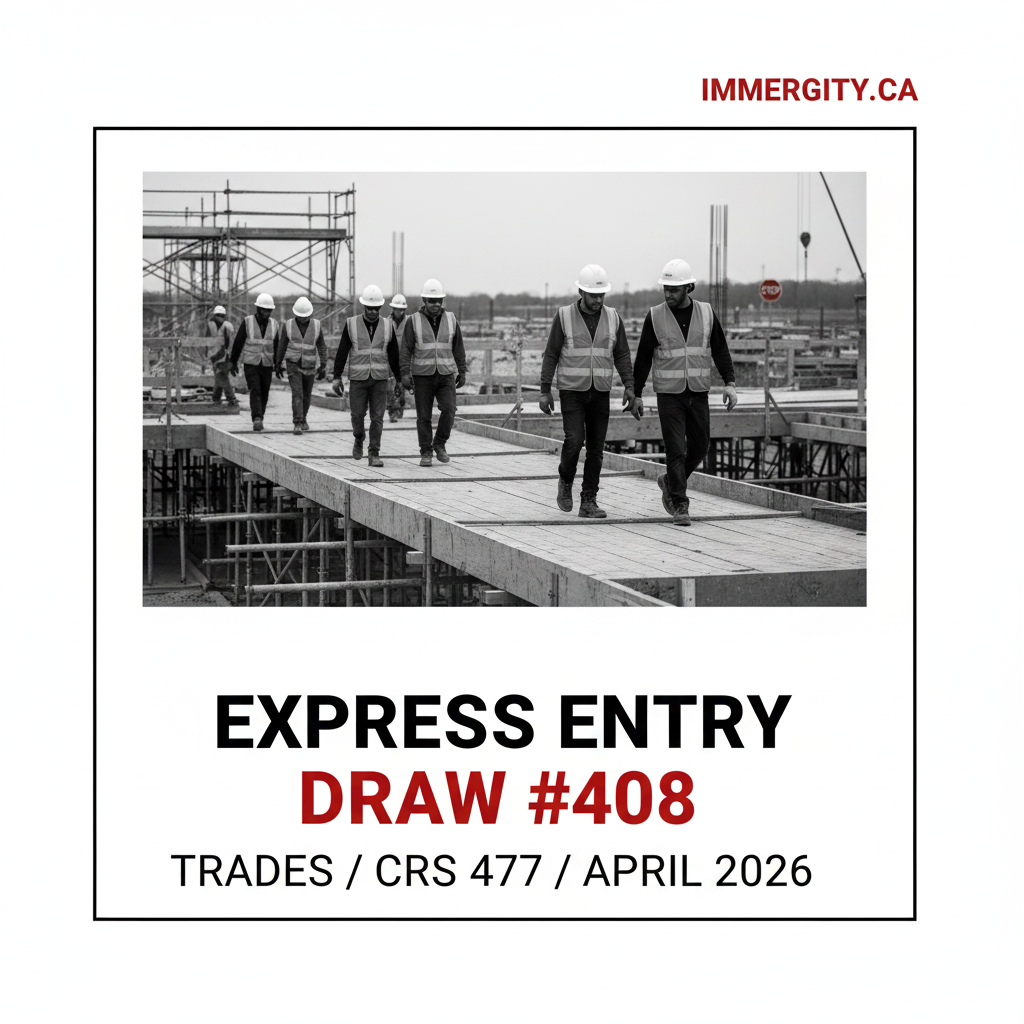
Immigration, Refugees and Citizenship Canada (IRCC) conducted Express Entry Draw #408 on April 2, 2026, issuing 3,000 Invitations to Apply (ITAs) to candidates under the Trades Occupations 2026-Version 3 category. The minimum CRS score required was 477 points — one of the lowest cutoffs seen in 2026 and a strong signal that Canada is actively prioritizing skilled tradespeople for permanent residence.
The full history of Express Entry rounds, including the exact CRS cutoff and ITA count for every draw, is published on the IRCC rounds of invitations page.
If you work in the trades and have been sitting on the Express Entry sidelines, this draw is your clearest signal yet to act. Use our Eligibility Assessment to see if you qualify today.
Draw #408 at a Glance
- Draw Date: April 2, 2026
- Draw Number: #408
- Program: Trades Occupations (2026-Version 3)
- CRS Cutoff: 477
- Invitations Issued: 3,000
What Is the Trades Occupations Category?
The Trades Occupations category under Express Entry targets candidates with experience in skilled trade roles — electricians, plumbers, carpenters, welders, heavy equipment operators, and similar NOC TEER 2 and 3 trades. This is a category-based selection draw, meaning IRCC specifically invites candidates whose primary NOC code falls within eligible trade occupations, regardless of whether they qualify for other programs like the Canadian Experience Class.
Category-based draws were introduced in 2023 to give IRCC flexibility to address specific labour market needs. Trades draws have consistently produced some of the lowest CRS cutoffs across all draw types — CRS 477 continues that trend and opens the door for candidates who would not score high enough in an all-program or CEC draw.
CRS 477 — What Does It Mean?
A cutoff of 477 is accessible for most trades workers with a year of Canadian or foreign skilled work experience, a CLB 5+ language score, and a valid ECA. Unlike CEC draws where candidates typically need CLB 9+ and Canadian experience, trades draws weight the occupation itself more heavily.
Here is what a typical qualifying profile looks like: a Red Seal electrician with 3 years of experience in Ontario, IELTS scores at CLB 7, and an ECA from WES. That profile easily clears 477 — in many cases with room to spare. Use our CRS Simulator to model your exact score.
Who Should Be Applying Right Now
If your NOC code falls in the following categories, this draw directly applies to you:
- Electricians, plumbers, pipefitters (NOC 7200s)
- Carpenters, cabinetmakers (NOC 7271–7272)
- Welders and related machine operators (NOC 7237)
- Heavy equipment operators (NOC 7521)
- Industrial mechanics and millwrights (NOC 7311)
- Sheet metal workers, boilermakers, ironworkers (NOC 7200s)
Not sure if your NOC qualifies? Our Eligibility Assessment maps your job title to the correct NOC code and confirms your draw eligibility in minutes.
How to Improve Your CRS if You Missed This Draw
A CRS of 477 is achievable for most trades workers, but if you are below this threshold, here is what moves the needle:
- Language testing: Even a modest improvement from CLB 6 to CLB 7 can add 10–20 CRS points. Use our CLB Converter to understand exactly where you stand.
- Provincial Nomination: Several provinces — including Alberta, Saskatchewan, and Nova Scotia — have active PNP streams for tradespeople. A nomination adds 600 CRS points instantly. Check your options with our PNP Program Finder.
- Canadian work experience: If you are currently working in Canada on a work permit, each year of Canadian experience adds CRS points and may eventually qualify you for the CEC stream as well.
- Spousal factors: If your spouse has strong language scores or Canadian education, adding them to your profile can boost your CRS. Our Spousal Sponsorship Evaluator can help you assess this.
My Take on Trades Draws in 2026
The frequency and volume of trades-category draws in 2026 is not accidental. Canada is facing a genuine skilled trades shortage driven by aging infrastructure, housing construction targets, and retiring tradespeople. IRCC is using Express Entry category-based draws as a direct policy response.
What this means practically: if you are a skilled tradesperson, your path to Canadian PR has never been more straightforward. The CRS bar is low, the draw frequency is increasing, and the provincial pathways are wide open. Do not wait for a perfect score — 477 is the proof that a good-enough profile beats a perfect profile that never gets submitted.
Book a strategy session through our Eligibility Assessment and let us build your specific action plan.
Frequently Asked Questions
What trades qualify for Express Entry Draw #408?
Draw #408 targeted Trades Occupations under NOC TEER 2 and 3 categories including electricians, plumbers, carpenters, welders, heavy equipment operators, and industrial mechanics. Use IMMERGITY's Eligibility Assessment to confirm your specific NOC code qualifies.
Is a CRS of 477 achievable for a typical trades worker?
Yes. Most trades workers with CLB 6+ language scores, a valid ECA, and one year of skilled work experience will score in the 460–500 range. Use the CRS Simulator to model your exact profile.
Do I need Canadian work experience for a trades draw?
No — unlike CEC draws, trades category draws accept foreign work experience in eligible NOC codes. You do not need to be currently living in Canada to qualify.
How often does IRCC hold trades draws?
In 2026, IRCC has been conducting trades draws roughly once every 4–6 weeks. Draw #408 (April 2) follows previous trades draws and signals continued commitment to this occupational category.
What is the difference between a trades draw and an all-program draw?
An all-program draw invites candidates from all Express Entry streams (FSW, CEC, CEC) competing together, which typically produces higher CRS cutoffs (500+). A trades draw only invites candidates whose primary NOC is in the trades category, resulting in lower cutoffs like 477.
How do I know if my province has a PNP stream for my trade?
Several provinces including Alberta, Saskatchewan, Manitoba, and Nova Scotia run active trades streams under their PNP. Use IMMERGITY's PNP Program Finder to match your occupation and province to active streams.